1917 Chinese Railroad Worker Killing Attempt
Train DreamsThe 1917 Chinese Railroad Worker Killing Attempt begins with a Chinese laborer caught—or merely accused—of stealing from the company stores of the Spokane International Railway in the Idaho Panhandle. What follows is not a formal investigation or an authorized punishment but a terrifying improvised execution attempt by railroad workers and a company manager. Robert Grainier is drawn into the effort, helps carry the prisoner toward a bridge sixty feet above the Moyea River, and afterward cannot separate the event from his memories of racial violence, personal responsibility, and the curse he believes the laborer called down upon him.
Accusation and Labor Setting
The incident takes place in the summer of 1917 amid the construction of the Eleven-Mile Cutoff Bridge, a project that would eventually carry a locomotive across a 112-foot gap above a 60-foot-deep gorge. The bridge belongs to the practical world of railroad expansion: a structure intended to eliminate a long curve around the gorge and an adjacent pass, saving the Spokane International Railway the expense of maintaining eleven miles of rails and ties. Yet the same worksite that represents coordinated industrial achievement also provides the setting for an uncontrolled act of racialized violence.
Three members of the railroad gang restrain the accused laborer and drag him up the long bank toward the bridge. Grainier encounters them while they are struggling and, seeing them in distress, lends assistance. He ends up holding one of the prisoner’s bare feet, while Mr. Sears, a representative of the Spokane International Railway’s management, holds the man almost uselessly by the armpit. Sears is the only participant besides the prisoner who speaks during the hardest part of the ascent, complaining, “Boys, I’m damned if we ever see the top of this heap!” The episode therefore brings management and labor into the same physical act, even though their authority and responsibilities are not identical.
The prisoner’s speech is incomprehensible to the men around him, who experience it as a rapid singsong rather than as testimony or an intelligible defense. His resistance—twisting, lashing backward with one free fist, and forcing the men to struggle for every yard—does not clarify the accusation. Instead, it intensifies their fear. The narrative leaves the theft itself unresolved: the man is described as caught, or anyway accused, of stealing, and no evidence of the alleged crime is presented. The lack of proof is central to the event’s moral structure, because the violence proceeds without establishing guilt.
The Attempted Execution
As the group climbs, the men repeatedly fall into the dust and right themselves. The prisoner’s resistance terrifies them, and the original intention, whatever it was, changes into a determination to kill him. The men conclude that nothing will do but to throw him from the trestle. Their language and actions reveal a collective panic in which fear substitutes for judgment and participation begins to feel like obligation.
A gang of roughly a dozen workers pauses in the sun to watch. Grainier remains attached to the struggle, holding the prisoner’s foot convulsively and wondering at his own conduct. The man holding the other foot lets go, sits gasping in the dirt, and is kicked in the eye before Grainier takes charge of the flailing limb. That participant tries to reduce the affair to play, saying, “It was just for fun. For fun,” and urges his companion Jel Toomis to abandon it. Toomis replies, “I can’t let loose,” because he is the one holding the prisoner by the neck. Grainier then tightens his embrace around both feet and declares, “Well, I’ve got him! I’ve got the bastard, and I’m your man!” His words mark the moment when assistance becomes identification with the execution party.
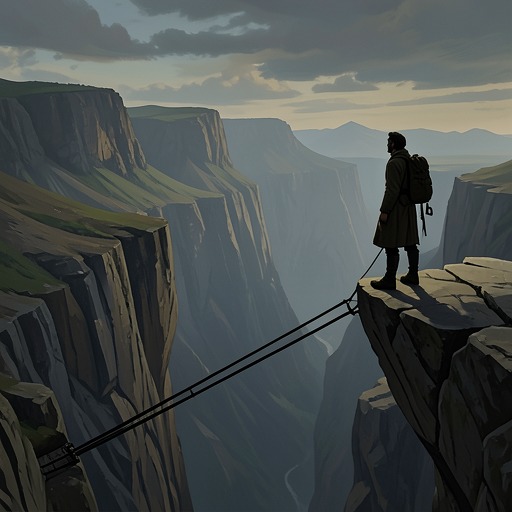
The executioners reach the middle of the last completed span, sixty feet above the rapids, and make repeated efforts to toss the laborer over the side. He survives by clinging to their arms and legs, weeping in the language the men cannot understand. At last he releases his hold on them and grabs the beam beneath him with one hand. Because his captors are trying to rid themselves of him, he kicks free, goes over the side, and begins moving hand over hand along the skeleton of the next span.
The escape turns the bridge into a perilous lattice above the gorge. The laborer balances, climbs, and drops from beam to beam like a circus artist, while Toomis’s companion rushes along a beam and kicks at his fingers. Some workers cheer the escape; others, uncertain why he is being pursued but convinced that the “villain” must be stopped, shout for his capture. The divided reaction shows that the crowd has inherited the violence without possessing a stable account of its cause.
Mr. Sears draws a large, old four-shot black-powder revolver from his belt holster and fires all four rounds, but none has any effect. By then the laborer has vanished. The gun, which converts the group’s improvised violence into an explicit attempt at armed killing, fails where the trestle’s height and the men’s collective force have also failed. The bridge remains standing, but its unfinished framework has briefly served as a potential gallows and then as the route of escape.
Grainier’s Immediate Aftermath
On the walk home, Grainier cannot leave the fugitive behind psychologically. He detours two miles to the store at Meadow Creek to buy a bottle of Hood’s Sarsaparilla for Gladys Grainier and their infant daughter, Kate Grainier, but in the falling dark he almost meets the Chinese laborer everywhere: in the road, in the woods, and emerging from the creek like a spider. These appearances are not presented as a confirmed return; they are the event’s immediate recurrence inside Grainier’s perception. The accused man has disappeared physically, yet the attempted killing follows Grainier home.
At the cabin, Grainier gives the tonic to Gladys Grainier, who is nursing four-month-old Kate Grainier beside the stove while suffering from salt rheum. The baby is also ill, with crusted eyes and a discharge at her nostrils, and does not seem to recognize her father. Against this domestic scene of ordinary care, Grainier stands worried that the laborer cursed the men powerfully while they dragged him. He is astonished by the frenzy of the afternoon and baffled by the violence that carried him away “like a seed in a wind,” yet he still wishes they had killed the man before the curse could take effect. His remorse is therefore immediate but incomplete: he recognizes the act’s frenzy while continuing to imagine that its intended victim possessed supernatural power to punish it.
Memory, Infrastructure, and Historical Violence
Forty-one days later, Grainier stands with the railroad gang as the first locomotive crosses the newly completed span. Mr. Sears raises his four-shooter to signal the commencement; at the sound of the gun, the engineer trips the brake, jumps out, and lets the single engine move slowly over the tracks. A second man waits at the far side to board and halt it before the rails end. The workers cheer, but Grainier feels sad without knowing why and then cheers with them. The same managerial weapon that failed to stop the laborer’s escape now initiates the bridge’s public triumph, creating a stark formal echo between attempted execution and technological progress.
The bridge’s inaugural crossing does not erase the earlier violence. Instead, the sequence places the two episodes in the same material frame: the trestle is celebrated as an efficient connection that saves the railway eleven miles of maintenance, but it is also remembered by Grainier as the place where a group nearly threw a man into the gorge. Industrial infrastructure appears neither simply heroic nor simply destructive. It organizes skilled collective labor and economic efficiency while also concentrating workers, authority, racial suspicion, and lethal force.
Grainier’s childhood memory deepens this pattern. His earliest recollection is of standing beside his uncle Robert Grainier, the First, in Fry and watching more than a hundred Chinese families being deported from the town. Men with axes, pistols, and shotguns guarded the Bonner Lumber Company railroad yard as the families climbed onto three flatcars. Decades later, when Grainier came close to killing a Chinese laborer himself, that earlier scene returned to his understanding of his own history. The 1917 attempt is thus not an isolated eruption: it repeats an older public spectacle of anti-Chinese exclusion and reveals how racial violence can be absorbed into the ordinary memory of American railroad and lumber communities.
The event also anticipates the way Grainier will measure later labor. After the bridge, he becomes hungry to work on ever larger undertakings, including the repair of the Robinson Gorge Bridge, a structure 208 feet deep and 804 feet wide that could support an engine and two flatcars of logs. He joins the Simpson Company, works among corduroy roads and six-horse teams, and serves as a choker, looping cables around eighteen-foot spruce logs. At the landing, the old wood-burning Steam donkey pays out and winds in cable while sending a hook to the choker. These later operations show the productive discipline that the killing attempt temporarily abandons: bodies, horses, timber, cables, engines, and bridges are coordinated to transform forests into transportable capital. The contrast makes the 1917 episode more disturbing, not less, because the same labor world capable of elaborate cooperation can redirect its organization toward a vulnerable human target.
Long-Term Consequences for Grainier
The attempted killing becomes one of the sources of Grainier’s lifelong guilt. Years afterward, when he is hauling along the Kootenai River, the image of William Coswell Haley, the dying boomer he had failed to help, returns to him, and so does the memory of the Chinese railroad hand he had almost helped to kill. The latter thought paralyzes his heart. Grainier becomes convinced that the man took revenge by calling down a curse that incinerated Gladys Grainier and Kate Grainier in the 1920 Moyea Valley Fire. The belief is not established as fact, but it governs his emotional interpretation of both events: the failed execution becomes a hidden cause of the later disaster, and personal guilt becomes a supernatural theory of punishment.
The connection persists even as Grainier’s life changes. He works as a freighter along Highway 2, later gives up logging after a wild limb knocks his jaw crooked and his joints deteriorate, and becomes a man whose body bears the accumulated hazards of industrial labor. His shoulder locks, his knee wobbles, and he is eventually finished as a woodsman. Although these injuries are not direct consequences of the 1917 attempt, they belong to the same world of hazardous work in which danger is repeatedly transferred onto individual bodies. The bridge incident is the earliest decisive moment in which Grainier discovers that his own body can be recruited into an institution’s violence; later, that body becomes visibly marked by the labor system he once relished.
The event’s historical resonance extends beyond Grainier’s private remorse. In the surrounding world, Chinese families had already been expelled from Fry, while the scattered remnants of China Basin were no longer treated as a threat by the time Grainier worked on bridges. The attempted killing therefore stands between public racial exclusion and the later fading of overt fear, preserving a moment when accusation could still mobilize a work gang, a manager, a bridge, and a revolver against one Chinese laborer. Its decisive significance lies in that convergence: the railroad’s drive to connect territory is shown alongside the social power to exclude, pursue, and nearly destroy the people whose presence the dominant community has marked as alien.